When a buyer asks about one of your cards at a show or across the counter, you need a number fast: what’s it worth, what do you open at, and where do you walk away. The Comps view on the card detail panel gives you those numbers on one screen, and you can save your own without ever touching your live TCGplayer listing. This tutorial walks the flow on your phone at the table. For the full reference on how the numbers are built, see Card detail and comparison.

Step 1: Open the card on the Cards tab

Open your dashboard, go to the Cards tab, and open the card you’re dealing on. The detail panel slides in with the card image, its facts, and a navigation row.

Step 2: Switch to the Comps tab

In the panel’s navigation row, tap Comps. This is the in-person negotiation view.
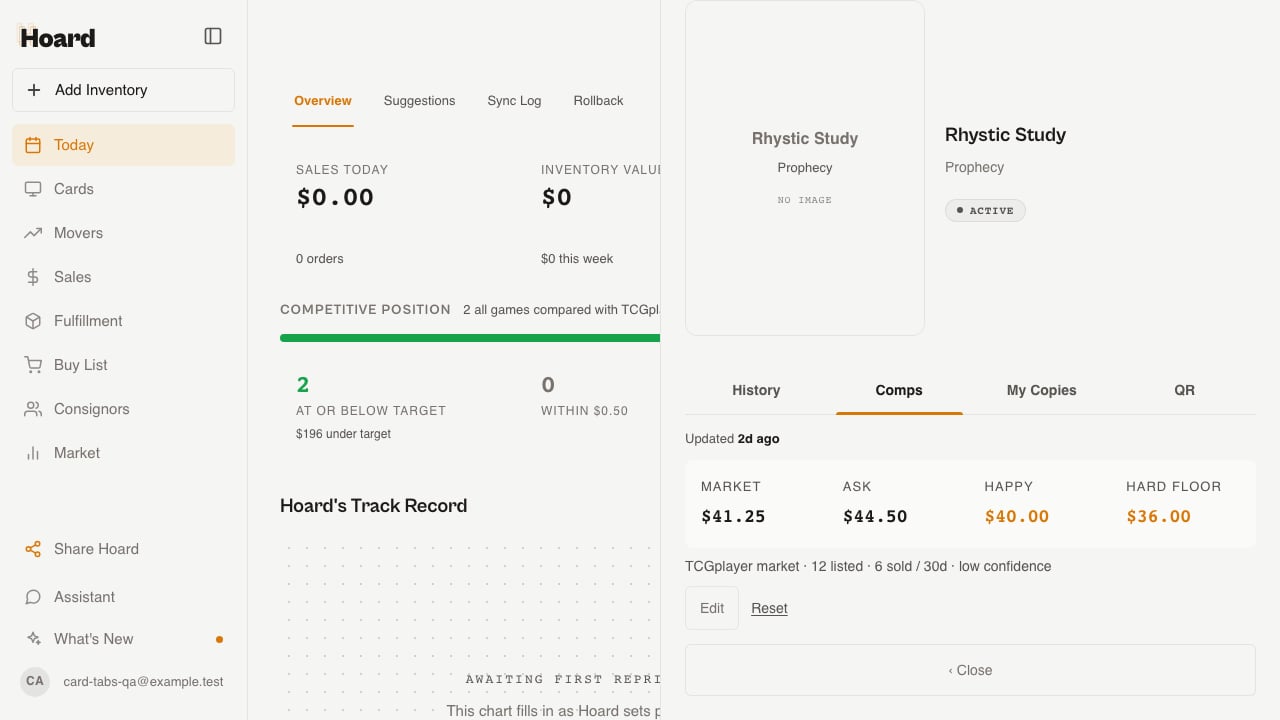
The card detail panel with the Comps tab active, showing the Market, Ask, Happy, and Hard floor number grid, an evidence line, and Edit and Reset controls

Step 3: Read the four numbers

Comps puts four numbers together for the deal:
  • Market — Hoard’s current estimate, preferring recent sales in the same condition.
  • Ask — the opening number you quote.
  • Happy — the price you’d feel good accepting.
  • Hard floor — the number below which you walk away.
The Ask and Happy numbers adjust for how the market is moving: a liquid card stays close to market, while a thin market or an active buy-out gives you more room. The Hard floor estimates what a standard TCGplayer Marketplace sale would net you before shipping, so you can compare an in-person offer against what selling online would leave you. An evidence line under the numbers tells you what they’re based on.

Step 4: Refresh for current listings and sales

Tap Refresh to pull current listings and recent sales for this card. This asks your online Hoard agent to fetch the latest data, so it needs your agent connected, and it starts on the agent’s next work cycle rather than instantly. The open panel updates itself when the fresh result lands, so you can keep it open while you talk. If the data is already fresh, the button tells you so.

Step 5: Save your own numbers

If you want to lock in your own plan for this card, tap Edit and set your own Ask, Happy, and Hard floor. These are negotiation notes. Saving them does not change your live TCGplayer listing and does not change Hoard’s repricing target, so you can jot down a walk-away for a card at a show without any risk to the price your store is actually running. Tap Reset to throw away your notes and return to Hoard’s current suggested numbers.

At the table

The panel is phone-friendly, so keep this view open while you negotiate: pull up the card, glance at Market / Ask / Happy / Hard floor, Refresh if you want fresh evidence, and make the call. Your saved notes stay with the card for the next time it comes up, and your live listing keeps doing its own thing the whole time. For how Market is chosen, how the floor is estimated, and how the numbers widen for a thin market, see the Comps section in Card detail and comparison.