

Upload a folder of photos
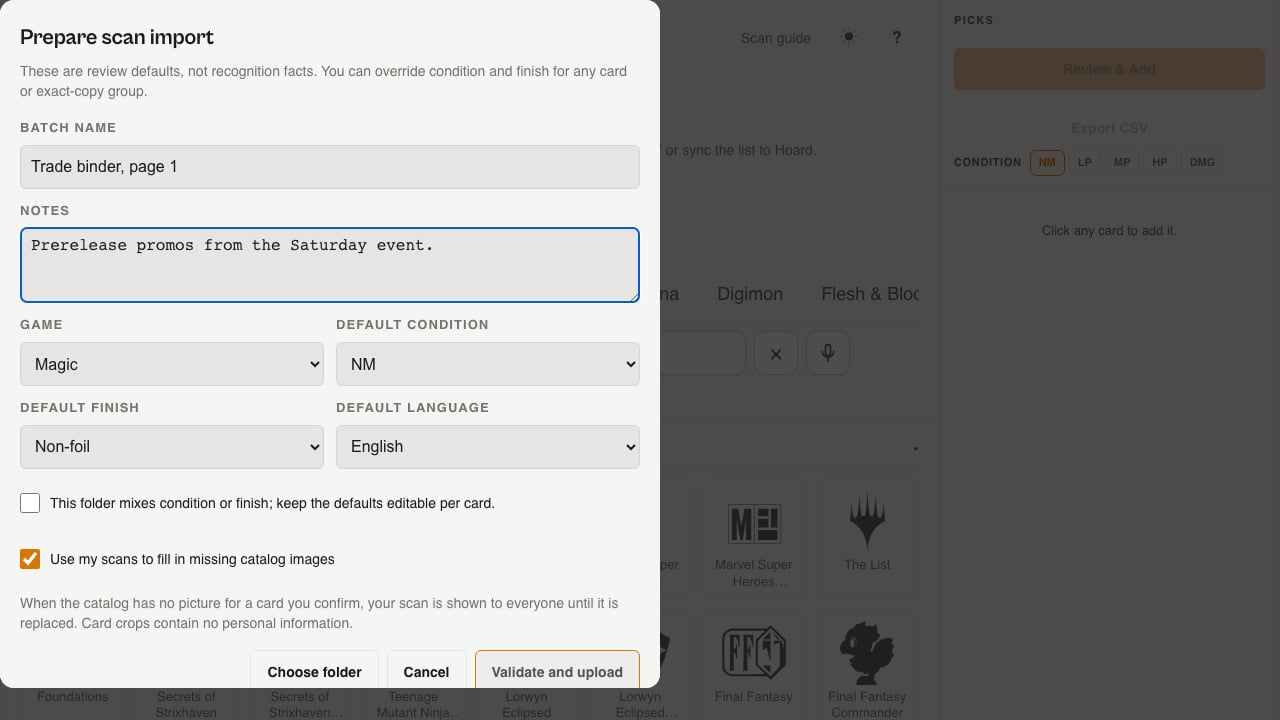
Go to/collect and click Import scans. Name the import, add any manager notes, and choose the game, default condition, finish, and language before selecting the folder. Choose mixed batch when the folder contains different conditions or finishes. These are starting values for review, not automatic claims about what the photos contain.
Matching happens off your browser
Once a batch finishes uploading, Hoard does the identification work: it cuts each photo into individual card crops, then compares each crop against your game’s catalog for the closest visual match. None of this runs in your browser tab, so you can close the tab and come back later. Open Your scans to find earlier imports by their card thumbnails and any import note, with links back to review. Visual matching normally returns its closest guesses, which is exactly why the review step exists: you confirm whether the best attempt is actually right. Identification evidence that cannot be validated may instead return no candidates and ask you to search manually. The dedicated review page opens immediately with a processing indicator and adds reviewable cards as results arrive. You can review those cards while the remaining photos continue in the background.Reviewing your results
Likely matches
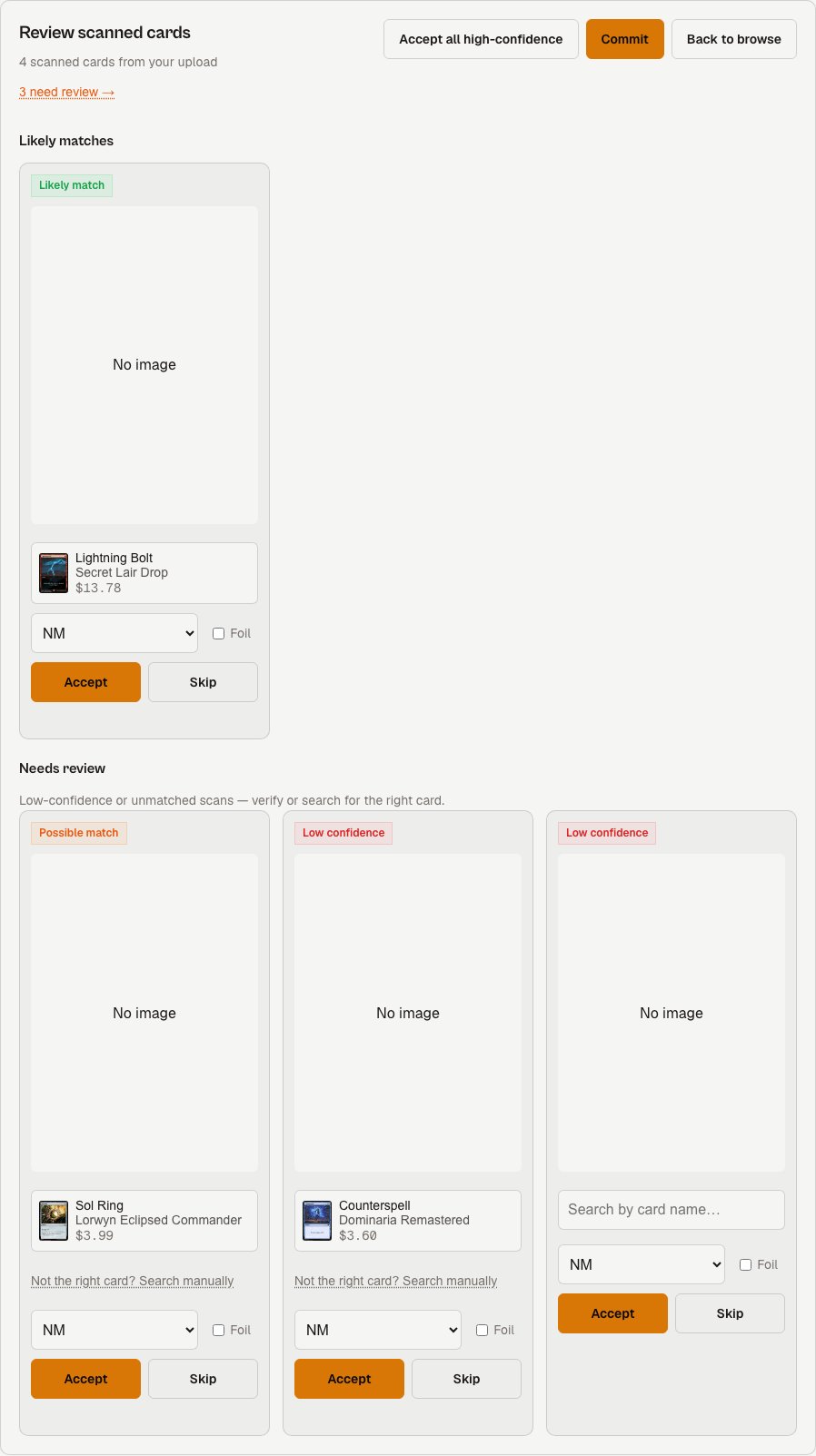
A green Likely match badge with a circled checkmark means Hoard is confident about the top candidate. Nothing is selected automatically: review these individually, or use Accept all likely matches when you trust the whole bucket. The High confidence filter below the summary filters the list to exactly those cards, so you can look them over before or after accepting them all.Needs review
Everything else is marked for review in the queue, with a badge that tells you why:- Possible match (circled question mark, orange) — Hoard found a plausible candidate but isn’t confident enough to call it likely.
- Low confidence (boxed exclamation mark, rose) — either the top candidate is a weak match, or nothing matched at all. Items with zero candidates show a manual search box only, since there’s nothing else to offer.
A Likely match badge is a strong signal, not a guarantee
Matching always returns its closest guesses, even on a game where catalog coverage is thin. If a whole batch looks off, with confident badges pointing at cards that clearly aren’t what you photographed, that game’s catalog probably doesn’t cover your cards well yet. Spot-check a few Likely matches the first time you scan a new game, and lean on manual search if something looks wrong.Accepting a card
Compare Your scan with Suggested match. Use the up/down controls beside the suggested image to cycle through candidates for this scan. Cycling previews a candidate without saving it. Set condition and finish, then click Accept beneath the suggested image; Skip is beside it. The queue marks that card accepted and advances to the next unresolved card. Accepting records the card together with the condition and finish you set, so what you commit is exactly what you chose.
When none of the candidates are right
Use Search all cards for a quick six-result name search. If the card still does not appear, click Browse catalog for the complete recovery view. It keeps the scan visible while you search the batch’s game by card name or exact printed number, filter by set, rarity, printing, or language, and load additional result pages.
Accept all likely matches at once
If you trust the Likely matches bucket and don’t want to click through each one, click Accept all likely matches beside the confidence filters. It accepts every eligible high-confidence item in the batch in a single action, at the default condition. You can still adjust any of them individually before staging.Adding accepted cards to staging
Accepting a match only saves your review choice. It does not create inventory and does not publish anything to TCGplayer. Once everything you care about is accepted, click Add selected to Hoard staging and confirm the number of selected cards. Accepted items become unpublished staged inventory with your current pricing rules. Anything unresolved or skipped is left out, and publishing to TCGplayer remains a separate confirmed action. If some selected cards cannot be staged, the successful cards stay staged and the failed cards remain available for correction. Fix those choices and add the selection again; Hoard appends only the corrected cards and does not double-count cards already staged by that scan. After staging, use View staged cards to inspect the exact inventory rows. Undo safely reverses the scan’s recorded inventory changes as long as none of those rows has since been edited, published, or used elsewhere in Hoard. Click Back to browse at any point to leave the review page. Your decisions are saved, and its direct review link remains available while the scan is active.Tips
- Select the right game tab before uploading. Matching only works within the game you picked, so a batch of Pokemon photos uploaded under the Magic tab won’t match against Pokemon cards.
- Space cards out in flatbed photos. Touching or overlapping cards in one photo can get skipped as a group.
- A rose badge with no candidates isn’t broken. It usually means the catalog doesn’t have that card yet, or the photo didn’t segment cleanly. Manual search still works for these.
- Spot-check the first batch on a new game. Coverage varies by game, so a quick look at your first few Likely matches tells you whether that game’s matching is dialed in yet.
- Photo quality matters more than photo count. A well-lit, in-focus photo with the card filling most of the frame matches better than a distant or blurry one.
- You can leave and come back. A batch isn’t lost if you close the tab mid-review — reopen its review link and pick up where you left off.