> ## Documentation Index
> Fetch the complete documentation index at: https://docs.tryhoard.com/llms.txt
> Use this file to discover all available pages before exploring further.
# Set up your pricing strategy
> Pick a Quick Start template or build your own. Walk through markup, floors, never-go-down, and when to use each.
Hoard prices your cards using a layered formula. Each layer takes the result of the previous one and adjusts it. You control the knobs. This tutorial walks through each setting so you understand what it does and when to change it.
***
## Start with a Quick Start template
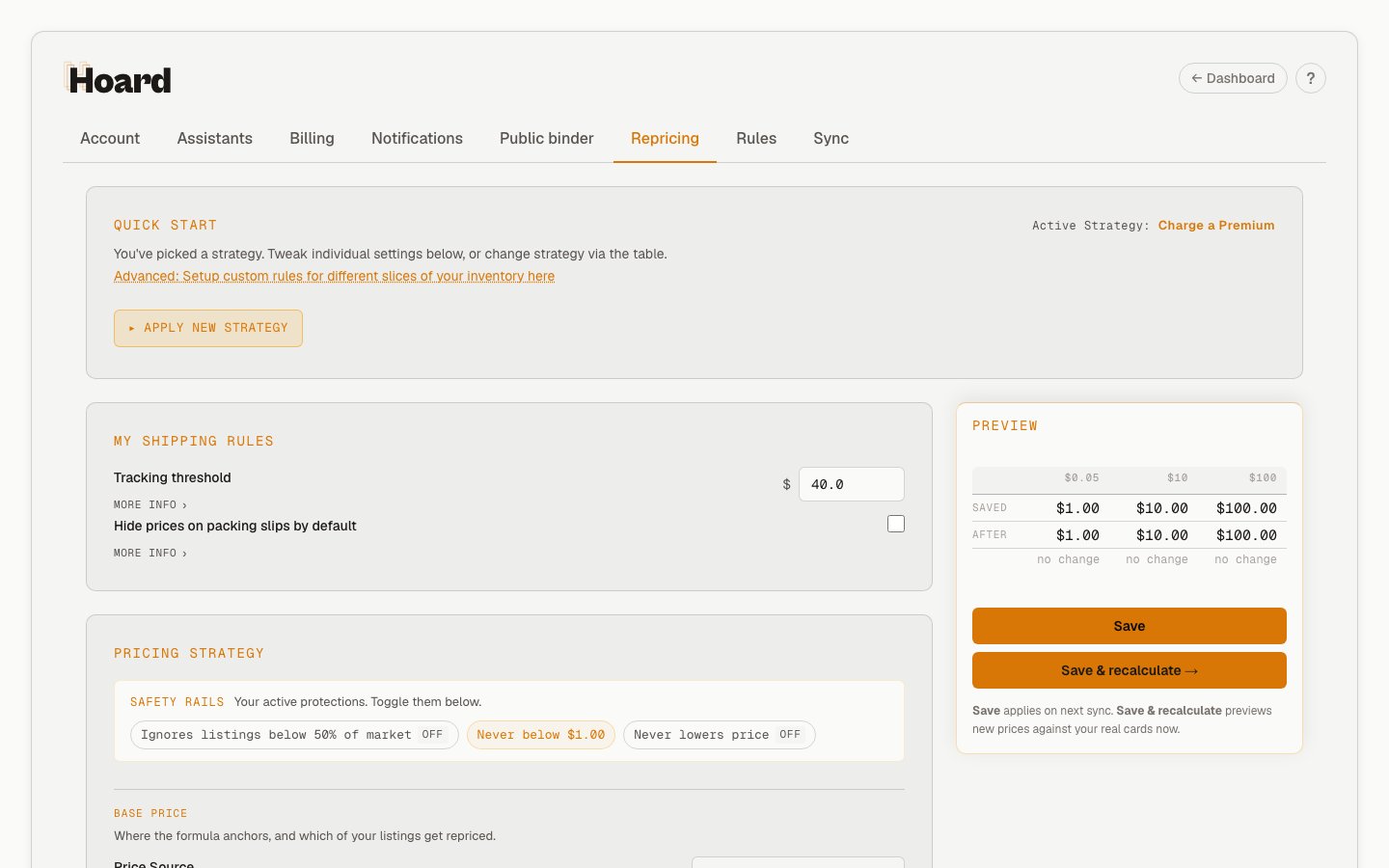
Go to **Settings > Pricing**. The top of the page shows four Quick Start templates side by side. Click any column header (or the per-column **Apply** button) to apply that template. Once a strategy is active, the table collapses by default; the amber **Apply New Strategy** button expands it again.
 ### Charge a Premium
Best for: patient sellers who'd rather miss a sale than leave money on the table.
What it sets:
* **5% markup** above market price
* **Never lower prices** — on
* **Undercut by 5%** — floor-aware, kicks in only when the lowest listing is above your formula
* **15% change cap on staples, 10% on cards under \$5** — hold mode, so big swings get skipped instead of partially absorbed
### Stay Competitive (recommended for most sellers)
Best for: matching the market without leading the race.
What it sets:
* **Market price × 1.0** — your target equals market
* **Never lower prices** — on
* **Undercut by 1%** — floor-aware. Lands a tick below the lowest listing so you win the tie without starting a race to the bottom.
* **20% change cap on staples, 15% under \$5** — hold mode
This is a balanced strategy. Your prices track the market upward but hold firm when it dips, and you stay just under the lowest listing when there's an obvious competitor.
### Move Product
Best for: clearing inventory.
What it sets:
* **Low price × 1.0** — your target equals the lowest listing
* **25% change cap on staples, 50% on cards under \$5** — clamp mode, so cheap commons swing freely
* **Velocity decay** — stale cards (sitting 60+ days) get a small weekly drop
### Win the Buy Box
Best for: aggressive sellers who want the buy box.
What it sets:
* **Low + shipping × 0.98** — priced just under the lowest listing including shipping
* **30% change cap on staples, 50% on cards under \$5** — clamp mode
* **Velocity boost** — fast sellers get bumped up automatically
***
## The individual settings
After applying a Quick Start template, you can adjust each setting individually. Here's what each one does and when you'd change it.
### What "market price" means
Throughout Hoard, "market price" refers to TCGplayer's **Market Price** field, which is their volume-weighted average of recent sales for a given card and condition. It's not the lowest listing and it's not a simple average. TCGplayer calculates it from actual completed transactions, weighted toward more recent and higher-volume sales. This is the number you see in the "MARKET" column on the Cards tab, and it's the starting point for all of Hoard's pricing calculations.
### Price Markup
A percentage added on top of that market price. This is the base of your pricing strategy.
| Markup | Effect | Good for |
| ------ | -------------------- | ---------------------------------------------------------------------- |
| 0% | Match market exactly | Move Product, high-volume stores |
| 5% | Light cushion | Charge a Premium default |
| 10-20% | Moderate premium | Sellers who want a small margin without losing buy-box competitiveness |
| 30%+ | Strong premium | Sellers with unique inventory or high reputation |
### High-Value Shipping Adder
Adds a configurable amount (default $5.49) to the target price for cards above your tracking threshold (default $50). This covers the cost of tracked bubble-mailer shipping that high-value orders typically require. Turn it on if you're eating shipping costs on expensive cards. Turn it off if you include shipping in your listed price already. See [Shipping cost adder](/features/pricing#shipping-cost-adder) for details.
### Never Lower Prices
When ON, Hoard will raise your prices when the market goes up but never lower them when the market drops. This protects you from:
* Bot-driven price crashes (someone lists 100 copies at 50% off)
* Temporary market dips that recover within days
* Flash sales by other sellers that don't reflect real value
When to turn it OFF: if you want prices to follow the market in both directions, or if you're using Move Product or Win the Buy Box to clear inventory.
### Minimum Card Price (Floor)
The absolute lowest price Hoard will set for any card. Nothing goes below this number, regardless of what the market says.
| Floor | When to use it |
| ------- | -------------------------------------------------------------------- |
| \$0.25 | Move Product — you want everything to sell |
| \$1.00 | Default. Penny cards get a floor that covers your time and shipping. |
| \$2.00+ | If you only want to sell cards worth your time to ship |
Why $1.00 works well: TCGplayer's cart optimizer routes buyers to sellers who can fill orders efficiently. Having a spread of $1-2 cards in your store makes your store attractive for bundled orders, even if those cards individually have slim margins. The floor keeps those cards from pricing at \$0.05 where they'd cost you money to ship.
***
## Per-card rules (optional)
The settings above apply to your entire inventory. If you want certain cards priced differently, you can set up per-card pricing rules using bookmarked searches.
For example:
* **Magic:** Reserved List cards at 1.50x (they only go up)
* **Pokemon:** `r:"Illustration Rare"` at 1.30x, or `game:pokemon_japan v:masterball` at a premium for Master Ball Pattern cards
* **One Piece:** `game:"one piece" v:manga` at a premium for manga-art printings
* **Any game:** Cards from a hot set at 1.30x, or bulk cards at 0.80x to move them faster
See the [bookmark and pricing rule tutorial](/tutorials/pin-and-price-reserved-list) for a step-by-step walkthrough.
Rules are evaluated top to bottom. The first rule that matches a card wins. You can drag them to reorder priority in **Settings > Pricing** under the Card Group Rules section at the bottom.
***
## How the layers work together
When Hoard prices a card, it runs through these steps in order:
1. **Start with price source** — your chosen base price ([Market or Low + Shipping](/features/pricing#price-source))
2. **Apply markup** — multiply by your markup percentage (e.g., base x 1.20 for 20%)
3. **Check the floor** — if the result is below your minimum, bump it up
4. **Floor-aware check** — if enabled, check against the [lowest listing](/features/pricing#lowest-listing-awareness) on TCGplayer
5. **Shipping adder** — if the card is above your tracking threshold, add shipping cost
6. **Self-bidding protection** — if you're already the lowest listing on TCGplayer (within 25 cents of the floor), hold at your current price so the markup doesn't bid you against yourself. Releases automatically if your formula thinks you're more than 2× underpriced. Always on, can't be turned off. See [Self-bidding protection](/features/pricing#self-bidding-protection).
7. **Change caps** — if enabled, limit how much the price can [change per sync](/features/pricing#price-change-safety)
8. **Never go down** — if enabled, don't let the price drop below your current listing
9. **Per-card rules** — if a pricing rule matches, override the markup for this card
The result is your **target price**, shown in the TARGET column on the Cards tab.
***
## After you change settings
The pricing footer is sticky and bundles a live preview alongside two save buttons:
* **Save** — writes the new strategy. It applies on your next sync.
* **Save & recalculate** — writes the strategy and immediately previews new prices against your real cards.
If you'd rather see the impact across your whole inventory without saving, you can also click **Preview Prices** in the toolbar, and Hoard re-runs the formula against your current inventory and shows a preview of every card that would change. Confirm to apply, or cancel to keep things as they are.
Either way, you can experiment: change a setting, preview the impact, decide if you like it, undo if you don't.
***
## Tips
* **Start conservative.** Stay Competitive is a safe default for most sellers. You can always loosen later.
* **Check the competitive position report after a sync.** If too many cards are in "20%+ Above," your markup might be too high. If everything is "At or Below Market," you might have room to raise it.
* **Never go down + high markup = slow sales.** If you set a 30% markup and Never Lower Prices, your prices will only go up. That's fine for Reserved List staples, but it'll strand bulk cards at prices nobody will pay.
* **Review once a week.** Pull up the Movers tab and the competitive position report. If the market moved significantly, your settings might need a nudge.
### Charge a Premium
Best for: patient sellers who'd rather miss a sale than leave money on the table.
What it sets:
* **5% markup** above market price
* **Never lower prices** — on
* **Undercut by 5%** — floor-aware, kicks in only when the lowest listing is above your formula
* **15% change cap on staples, 10% on cards under \$5** — hold mode, so big swings get skipped instead of partially absorbed
### Stay Competitive (recommended for most sellers)
Best for: matching the market without leading the race.
What it sets:
* **Market price × 1.0** — your target equals market
* **Never lower prices** — on
* **Undercut by 1%** — floor-aware. Lands a tick below the lowest listing so you win the tie without starting a race to the bottom.
* **20% change cap on staples, 15% under \$5** — hold mode
This is a balanced strategy. Your prices track the market upward but hold firm when it dips, and you stay just under the lowest listing when there's an obvious competitor.
### Move Product
Best for: clearing inventory.
What it sets:
* **Low price × 1.0** — your target equals the lowest listing
* **25% change cap on staples, 50% on cards under \$5** — clamp mode, so cheap commons swing freely
* **Velocity decay** — stale cards (sitting 60+ days) get a small weekly drop
### Win the Buy Box
Best for: aggressive sellers who want the buy box.
What it sets:
* **Low + shipping × 0.98** — priced just under the lowest listing including shipping
* **30% change cap on staples, 50% on cards under \$5** — clamp mode
* **Velocity boost** — fast sellers get bumped up automatically
***
## The individual settings
After applying a Quick Start template, you can adjust each setting individually. Here's what each one does and when you'd change it.
### What "market price" means
Throughout Hoard, "market price" refers to TCGplayer's **Market Price** field, which is their volume-weighted average of recent sales for a given card and condition. It's not the lowest listing and it's not a simple average. TCGplayer calculates it from actual completed transactions, weighted toward more recent and higher-volume sales. This is the number you see in the "MARKET" column on the Cards tab, and it's the starting point for all of Hoard's pricing calculations.
### Price Markup
A percentage added on top of that market price. This is the base of your pricing strategy.
| Markup | Effect | Good for |
| ------ | -------------------- | ---------------------------------------------------------------------- |
| 0% | Match market exactly | Move Product, high-volume stores |
| 5% | Light cushion | Charge a Premium default |
| 10-20% | Moderate premium | Sellers who want a small margin without losing buy-box competitiveness |
| 30%+ | Strong premium | Sellers with unique inventory or high reputation |
### High-Value Shipping Adder
Adds a configurable amount (default $5.49) to the target price for cards above your tracking threshold (default $50). This covers the cost of tracked bubble-mailer shipping that high-value orders typically require. Turn it on if you're eating shipping costs on expensive cards. Turn it off if you include shipping in your listed price already. See [Shipping cost adder](/features/pricing#shipping-cost-adder) for details.
### Never Lower Prices
When ON, Hoard will raise your prices when the market goes up but never lower them when the market drops. This protects you from:
* Bot-driven price crashes (someone lists 100 copies at 50% off)
* Temporary market dips that recover within days
* Flash sales by other sellers that don't reflect real value
When to turn it OFF: if you want prices to follow the market in both directions, or if you're using Move Product or Win the Buy Box to clear inventory.
### Minimum Card Price (Floor)
The absolute lowest price Hoard will set for any card. Nothing goes below this number, regardless of what the market says.
| Floor | When to use it |
| ------- | -------------------------------------------------------------------- |
| \$0.25 | Move Product — you want everything to sell |
| \$1.00 | Default. Penny cards get a floor that covers your time and shipping. |
| \$2.00+ | If you only want to sell cards worth your time to ship |
Why $1.00 works well: TCGplayer's cart optimizer routes buyers to sellers who can fill orders efficiently. Having a spread of $1-2 cards in your store makes your store attractive for bundled orders, even if those cards individually have slim margins. The floor keeps those cards from pricing at \$0.05 where they'd cost you money to ship.
***
## Per-card rules (optional)
The settings above apply to your entire inventory. If you want certain cards priced differently, you can set up per-card pricing rules using bookmarked searches.
For example:
* **Magic:** Reserved List cards at 1.50x (they only go up)
* **Pokemon:** `r:"Illustration Rare"` at 1.30x, or `game:pokemon_japan v:masterball` at a premium for Master Ball Pattern cards
* **One Piece:** `game:"one piece" v:manga` at a premium for manga-art printings
* **Any game:** Cards from a hot set at 1.30x, or bulk cards at 0.80x to move them faster
See the [bookmark and pricing rule tutorial](/tutorials/pin-and-price-reserved-list) for a step-by-step walkthrough.
Rules are evaluated top to bottom. The first rule that matches a card wins. You can drag them to reorder priority in **Settings > Pricing** under the Card Group Rules section at the bottom.
***
## How the layers work together
When Hoard prices a card, it runs through these steps in order:
1. **Start with price source** — your chosen base price ([Market or Low + Shipping](/features/pricing#price-source))
2. **Apply markup** — multiply by your markup percentage (e.g., base x 1.20 for 20%)
3. **Check the floor** — if the result is below your minimum, bump it up
4. **Floor-aware check** — if enabled, check against the [lowest listing](/features/pricing#lowest-listing-awareness) on TCGplayer
5. **Shipping adder** — if the card is above your tracking threshold, add shipping cost
6. **Self-bidding protection** — if you're already the lowest listing on TCGplayer (within 25 cents of the floor), hold at your current price so the markup doesn't bid you against yourself. Releases automatically if your formula thinks you're more than 2× underpriced. Always on, can't be turned off. See [Self-bidding protection](/features/pricing#self-bidding-protection).
7. **Change caps** — if enabled, limit how much the price can [change per sync](/features/pricing#price-change-safety)
8. **Never go down** — if enabled, don't let the price drop below your current listing
9. **Per-card rules** — if a pricing rule matches, override the markup for this card
The result is your **target price**, shown in the TARGET column on the Cards tab.
***
## After you change settings
The pricing footer is sticky and bundles a live preview alongside two save buttons:
* **Save** — writes the new strategy. It applies on your next sync.
* **Save & recalculate** — writes the strategy and immediately previews new prices against your real cards.
If you'd rather see the impact across your whole inventory without saving, you can also click **Preview Prices** in the toolbar, and Hoard re-runs the formula against your current inventory and shows a preview of every card that would change. Confirm to apply, or cancel to keep things as they are.
Either way, you can experiment: change a setting, preview the impact, decide if you like it, undo if you don't.
***
## Tips
* **Start conservative.** Stay Competitive is a safe default for most sellers. You can always loosen later.
* **Check the competitive position report after a sync.** If too many cards are in "20%+ Above," your markup might be too high. If everything is "At or Below Market," you might have room to raise it.
* **Never go down + high markup = slow sales.** If you set a 30% markup and Never Lower Prices, your prices will only go up. That's fine for Reserved List staples, but it'll strand bulk cards at prices nobody will pay.
* **Review once a week.** Pull up the Movers tab and the competitive position report. If the market moved significantly, your settings might need a nudge.